

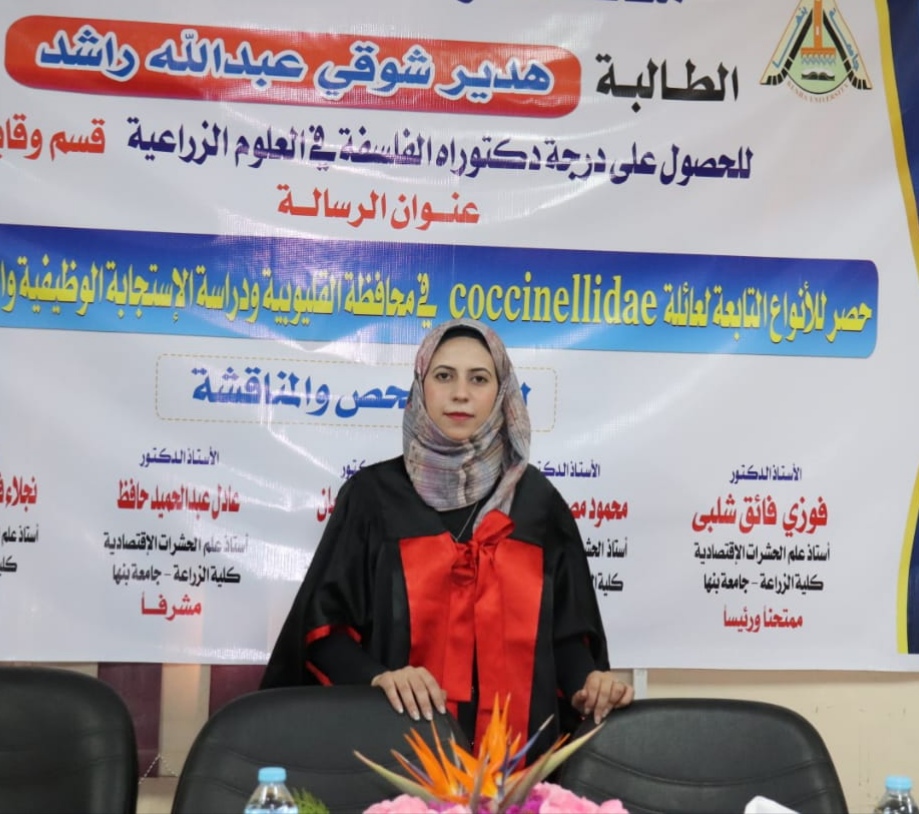
هدير شوقى راشد
مدرس
First Record of Barylypa rufa (Hölmgren 1857) as Parasitoid on Spodoptera frugiperda (Smith) from the Egyptian Fauna
Alex. J. Agric. Sci. Vol. 69, No.4, pp. 537-543, 2024 • 2024
معلومات البحث
المؤلفون
Not Available
الكلمات المفتاحية
Not Available
المجلة العلمية
Alex. J. Agric. Sci. Vol. 69, No.4, pp. 537-543, 2024
الناشر
Not Available
المجلد
Not Available
العدد
Not Available
الصفحات
Not Available
publication.type
Local
رابط البحث
Not Available
المواد المرفقة
Not Available
الملخص
Fall Armyworm Spodoptera frugiperda is a new pest that invaded Egyptian fields and has destroyed
many economic crops, including maize, sorghum, and rice due to its voracious appetite. Natural enemies
play a great role in controlling population densities of this pest, the parasitoid Barylypa rufa is a successful
parasitoid on genus Spodoptera i.e. S. littoralis and S. exigua in nature. In this study, B. rufa was observed
and recorded as a larval - pupal parasitoid on S. frugiperda for the first time from the Egyptian fauna. The
present work also covers the diagnostic and recognition characteristics of B . rufa adults (head capsule,
antenna, wings, legs, and abdomen). Ultimately, with this discovery of the parasitoid B. rufa as an
important bio-control agent, which biologically participates in the suppression of FAW populations
naturally under Egyptian conditions, its role in the Egyptian agricultural environment should be enhanced
to contribute to the development of FAW control strategies.
many economic crops, including maize, sorghum, and rice due to its voracious appetite. Natural enemies
play a great role in controlling population densities of this pest, the parasitoid Barylypa rufa is a successful
parasitoid on genus Spodoptera i.e. S. littoralis and S. exigua in nature. In this study, B. rufa was observed
and recorded as a larval - pupal parasitoid on S. frugiperda for the first time from the Egyptian fauna. The
present work also covers the diagnostic and recognition characteristics of B . rufa adults (head capsule,
antenna, wings, legs, and abdomen). Ultimately, with this discovery of the parasitoid B. rufa as an
important bio-control agent, which biologically participates in the suppression of FAW populations
naturally under Egyptian conditions, its role in the Egyptian agricultural environment should be enhanced
to contribute to the development of FAW control strategies.